
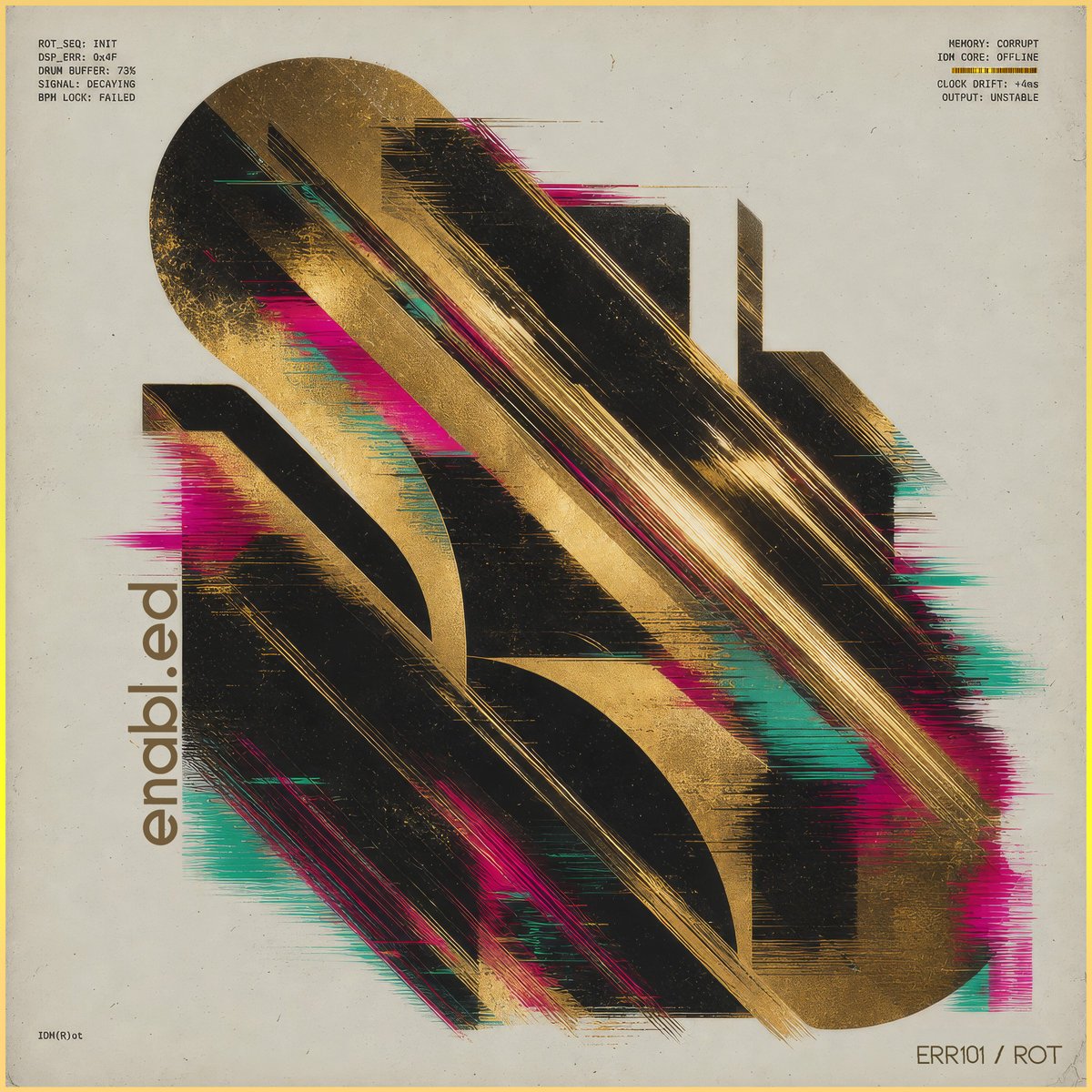
Clean Error Records has spent its catalog treating malfunctionism as a vital compositional language, and IDM(R)ot I is a striking entry in that lineage. Fifteen tracks deep, enabl.ed shows his fluency in this particular language, and entire arguments are posed in this strange and exotic tongue: Rot as method, iteration as compositional principle. The title is the album’s working method, and the record spends its fifteen tracks proving the method holds up under pressure.
“initiate.rot.heirloom” and “fragmented joyloader” establish the record’s core architecture with almost pedagogical clarity: crystalline synth melody suspended above deep, near-subsonic bass, with granular IDM percussion occupying the negative space between them. The percussive elements here: clicks, shuffles, textural glitch-fragments — they behave with a restraint bordering on deference, never encroaching on melodic territory, only ever articulating the silence around it. This is the album’s grammar, laid bare before any of its other dialects appear.
“rot.protocol_113” marks the first significant deviation, abandoning melodic warmth for bent, aggressive sub-bass kicks and drums locked into obsessive repetition, with alien pads surfacing only intermittently from the periphery. It is the album’s most minimal, most hostile gesture, useful precisely because it re-contextualizes everything that follows. “Rhythm Corruptor” extends this vocabulary of unpredictability to its furthest point on the record’s front half: percussion arranged with genuine unpredictability, refusing steady tempo, undergirded by sparse, dissonant, faintly menacing ambient synth. At 4:55 the track executes a total inversion — chaos yielding, without warning, to an intricate bass-synth rhythm and glassy melodic overlay, darkness resolving into brightness in a single cut. It stands as the clearest demonstration on the album of enabl.ed wielding structural rupture as a deliberate compositional tool.
“Rotcore Ethics” pushes this idea toward something closer to collapse. A distorted but legible lead melody, punctuated by long pauses after each flourish, meets drums that behave drunkenly — arrhythmic, unmoored, occasionally erupting into metallic screeching before the track fades to near-silence at the two-minute mark. What follows is a passage of pulsating static giving way to mournful, sparse synth work: the track effectively bifurcates into two compositions joined by a moment of digital erasure.
“Every Genre Contains Its Own Extinction” closes this thread of controlled dissolution with the album’s most maximal statement. Orchestral samples — strings, foley, fragmented instrumental gestures — assemble into a mosaic built from broken source material, anchored by repeating, dissonant bass while the ostensible chaos gradually reveals its own internal coherence. The title reads as commentary: genre consuming and repurposing its own material until the source becomes unrecognizable, then legible again in a completely new configuration.
Against this current of controlled entropy runs a quieter, more intimate thread. “Machine Empathy” softens the album’s percussive vocabulary considerably, allowing gorgeous, downtempo synth pads to dominate while glitch elements are introduced gradually, used almost as ornamentation; a closing choral vocal passage lends the track unexpected warmth. “Time-Stretched Memories” pushes this interiority further, pairing a lead melody of genuine emotional weight with sparse, intermittent glitch-percussion that never threatens the track’s essential humanity, before dissolving its own melodic structure at the close with real tenderness. “There Are Ghosts In The Sequencer” represents the logical endpoint of this withdrawal: percussion abandoned entirely in favor of field recording, near-imperceptible textural movement, and ambient air. It stands as the album’s most conceptually daring track, refusing the genre vocabulary the record has spent its runtime establishing.
Between these two poles — structural rupture and interior withdrawal — sits a substantial body of work operating in a register best described as controlled elaboration. “Error Inheritance_02” opens on feedback-like sounds, strings and analogue warmth before settling into a warbling, LFO-drenched monosynth lead atop a genuinely varied braindance percussion kit. “Braindance Rotted to the 10th Iteration” deconstructs the formula further while maintaining absolute internal coherence, standing as one of the record’s most accomplished demonstrations of controlled abstraction. “Rotkernel” and “Failed Futurism” revisit the melody-over-glitch template with smaller variations in synth timbre and rhythmic density, functioning as the album’s connective tissue. “Tempo.Dissolve” accelerates the percussive vocabulary considerably without sacrificing the soft, repeating pad-melody beneath it. “Reverb Of A Dead Catalog” pursues maximal density — distorted drums, heavy sub-bass, dense texture — while still carving space for long, drawn-out metallic pad tones underneath.
IDM(R)ot I treats structural rupture, textural restraint, and melodic warmth as vital parts of a single compositional intelligence. Songs that could easily collapse into noise instead hold together through deliberate architecture, with malfunctionism operating as an instrument in its own right, not as damage applied to otherwise conventional compositions. enabl.ed commands this specific vocabulary with a discipline and emotional range not often encountered. An outstanding release for Clean Error Records.
IDM(R)ot I by enabl.ed released on August 28th 2026 exclusively on Clean Error Records