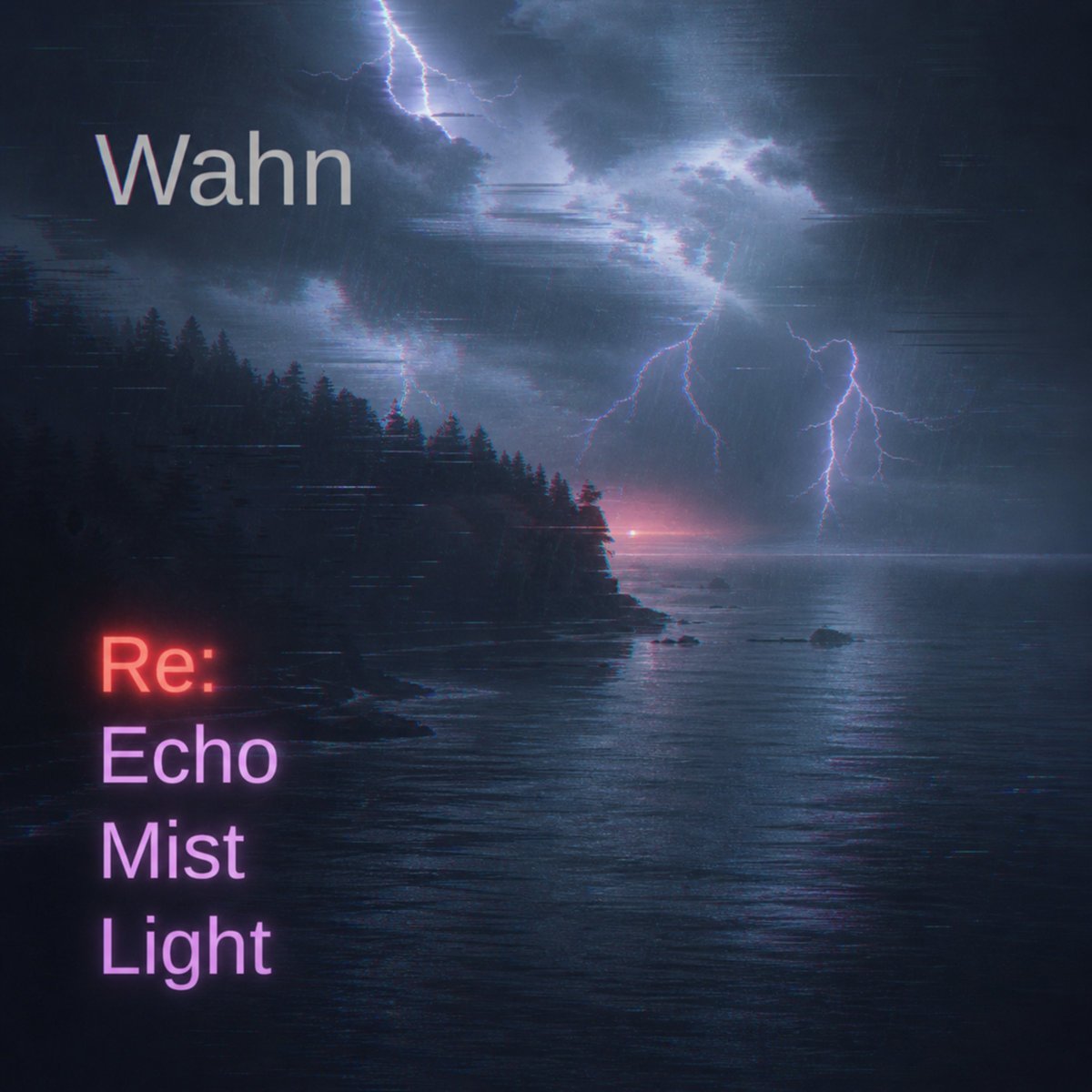
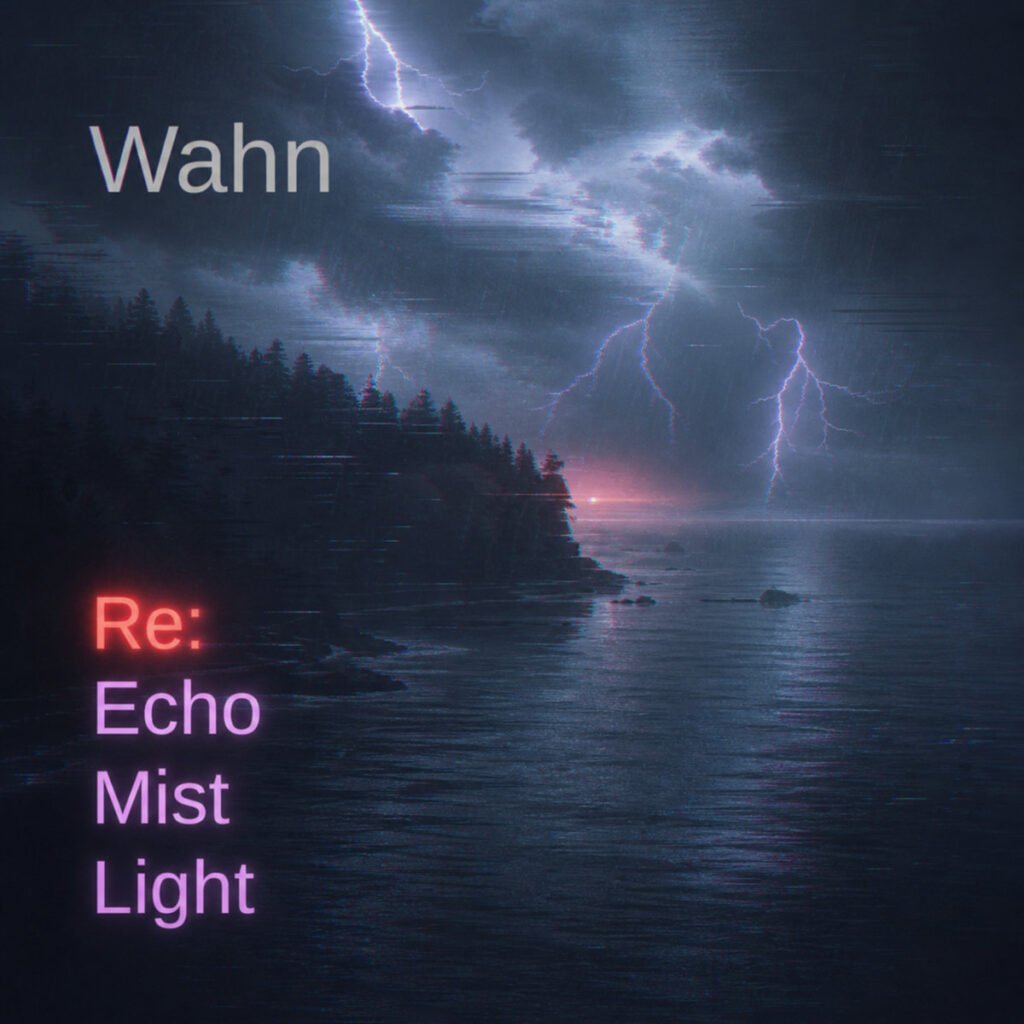
With Re: Echo Mist Light, Mahorka marks an extraordinary milestone: five hundred releases. That figure alone speaks to a rare consistency of purpose spanning decades, but the choice of source material makes the celebration particularly fitting. Wahn’s Echo Mist Light, issued earlier this year, was already a work deeply concerned with continuity, atmosphere, and the slow evolution of form. Rather than constructing music around peaks, catharsis, or dramatic narrative turns, the album explored density, restraint, and immersion. Rhythm functioned as a necessary architecture. Bass frequencies formed the structural foundations while echoes, grains of texture, and carefully managed harmonic fragments accumulated with patient intent. The record occupied a liminal territory between techno, ambient music, and dub-informed spatial design, prioritising depth and internal movement over spectacle.
Echo Mist Light was so particularly compelling because of its discipline. Tension was present throughout, yet rarely released. Melodic gestures appeared sparingly, illuminating the surrounding darkness without disrupting it. Wahn demonstrated a notable talent for organising space itself into a compositional element, allowing delays, reverberations, and lingering tonal residues to become active participants in the music’s unfolding. The result was an album possessing unusual clarity of purpose, one that treated atmosphere not as decoration but as structure.
A remix project built from such material could have easily become a collection of stylistic curios detached from the original’s identity. Instead, Re: Echo Mist Light functions as a fascinating examination of the many latent possibilities already embedded within the source material. The contributing artists rarely treat Wahn’s compositions as fixed objects. Rather, they approach them as conceptual frameworks, extracting different aspects of their DNA and pushing those qualities toward distinct conclusions.
Genda’s reinterpretation of “Something Opens” establishes the tone beautifully. The remix leans into contemporary IDM aesthetics, grinding slowly through dark, bass-heavy terrain before allowing fragments of melody to emerge from the surrounding pressure. It retains the original’s sense of patience while emphasising physicality. SignalStoerung’s version of “A Familiar Unease” proves equally intriguing. Its impossibly slow-motion rhythmic language, deep bass presence, and forlorn expanses of synthesiser create a strange temporal suspension. The track feels less like a remix than a deliberate manipulation of perception itself.
Valance Drakes approaches “Not All Is Lost” from a highly textural perspective. Airy pads, radio static, phantom transmissions, orchestral traces, and engulfing currents of noise circulate around one another in a fascinating state of instability. The piece continuously suggests recognisable forms only to dissolve them again. Mas&Delayer provide one of the collection’s most immediately satisfying moments with their version of “Call of the Beacon”, building a slow breakbeat groove that balances an almost-funk spirit, atmosphere, and intricate sound design with remarkable assurance.
Several contributors engage more directly with the darker dimensions of Wahn’s music. Fluffy Inside’s “Pressure Below” preserves much of the original’s shadowy character while reconfiguring it through an abstract hybrid-techno framework. The growling bass figures are especially effective. Méconium’s interpretation of the same composition ventures further into experimental territory, constructing a mechanised and almost cybernetic rhythmic organism from distorted synthesis and repeating structural patterns. Similarly, more alchemy occurs as Flint Glass transforms “Aligned Frequencies” into something simultaneously aggressive and ambient, a paradoxical work whose fractured energy remains compelling throughout.
The album also excels when it embraces quieter and more introspective territory. Abdicant and Nonima‘s treatment of “Phase Memory” replaces some of the original’s weight with drifting melodic warmth and expansive bass swells, creating an interpretation that feels open and restorative without losing the source material’s contemplative core. Grosso Gadgetto approaches “A Familiar Unease” from a markedly different angle, introducing a gentle rhythmic swing and bright, airy electronics that resist easy categorisation. Neither downtempo nor lounge, neither hip-hop nor conventional ambient electronica, the piece occupies an intriguing middle ground all its own. Dissolved’s version of “Not All Is Lost” unfolds like a spectral landscape assembled from textures, faint melodies, and drifting sonic artefacts. Cognition Delay’s remarkable “Finding Safety” reworking of “A Familiar Unease” may be one of the collection’s defining achievements: dreamlike, suspended, and profoundly atmospheric, it inhabits a space somewhere between ambient music and memory itself. Mitoma‘s interpretation of “Phase Memory” travels in the opposite direction from Abdicant and Nonima‘s luminous reworking, descending into a world of abstract percussion, darkness, and heavily textured IDM experimentation. Slow-moving bass pressure and cavernous atmospherics give the track an almost subterranean quality, making it one of the compilation’s most compelling excursions into shadow.
Elsewhere, the album demonstrates impressive stylistic breadth without sacrificing cohesion. Attaché delivers a forceful, club-oriented interpretation of “No Release Point,” while Brainquake pushes “A Quiet Glow” toward a more traditionally braindance-oriented vocabulary where restless percussion becomes the primary narrative voice. Captive Portal brings “Residual Motion” into a world of glitches and fractured digital surfaces before gradually revealing a whimsical and unexpectedly melodic heart. MEION’s reconstruction of “Call of the Beacon” may be the most radical departure on the record, turning the source into a kinetic collage of experimental rhythmic ideas, metallic textures, and destabilised temporal relationships.
One of the project’s greatest strengths lies in how frequently multiple artists gravitate toward entirely different aspects of the same composition. The recurring appearances of “A Familiar Unease,” “Not All Is Lost,” “Pressure Below,” “Phase Memory,” and “Call of the Beacon” create fascinating points of comparison. Rather than revealing limitations in the source material, these repetitions highlight its richness. Each new interpretation illuminates another contour, another possibility hidden within Wahn’s original structures.
There are even moments where the abstract threatens to wash away the levee. It is during Mentome Moir’s reworking of “Something Opens” that the track establishes itself as an exquisitely glowing and spacious environment of piano fragments, drones, reverberant strings, and ghostly textures. The closing percussion passages enter the composition with a loose, even haphazard armada of percussive hits arranged somewhat chaotically. But even then, the experimentation remains sincere and intellectually engaged rather than merely provocative.
The compilation closes with Substak‘s interpretation of “All Is Lost”, a fitting final statement that brings many of the album’s recurring concerns together. Ambient drones and deep bass resonance underpin intricate IDM percussion that chatters through the mix as a textural presence rather than a rhythmic command. As the track gradually sheds its complexity and gives way to luminous synth harmonies, the album arrives at a conclusion that feels neither conclusive nor final, but quietly open-ended. It is an elegant ending to a collection built on the notion that these compositions can continue to evolve through the perspectives of other artists.
As a commemorative release, it is entirely appropriate for Mahorka’s five-hundredth entry. Re: Echo Mist Light embodies the label’s ethos at every turn. It honours the original album not by preserving it unchanged, but by demonstrating how fertile its creative foundations truly are. Re: Echo Mist Light is a collection of considerable depth, one that transforms a remix album into something far more substantial: a multifaceted study of a remarkable work viewed through eighteen distinct perspectives.
Re: Echo Mist Light by Wahn releases 14 July 2026, exclusively on Mahorka