
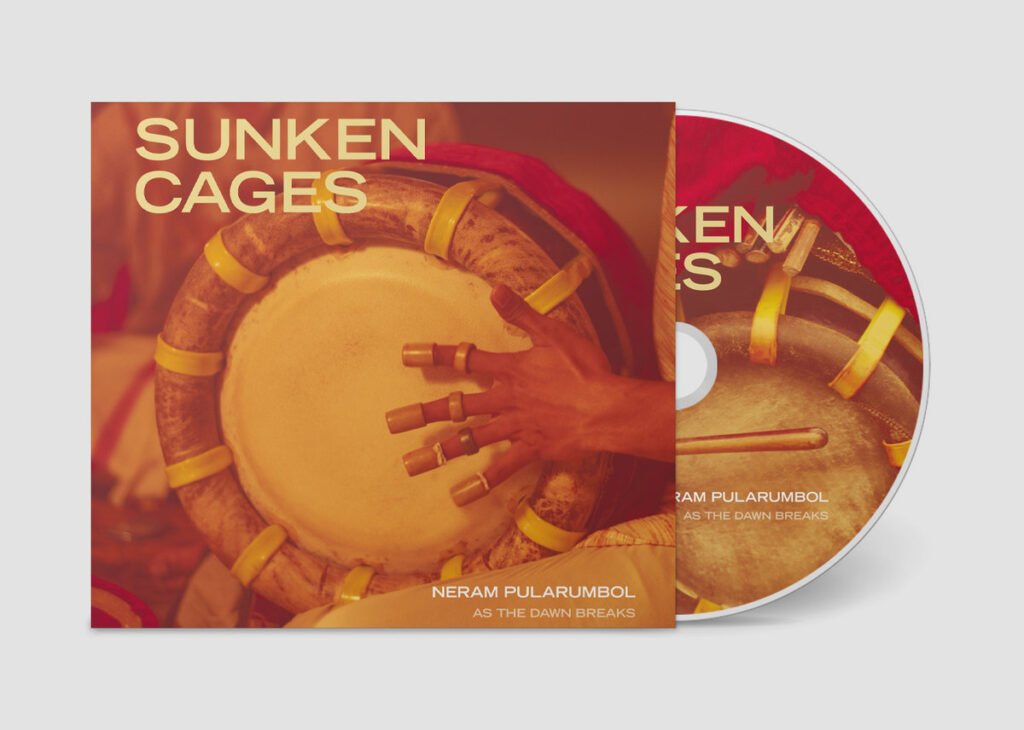
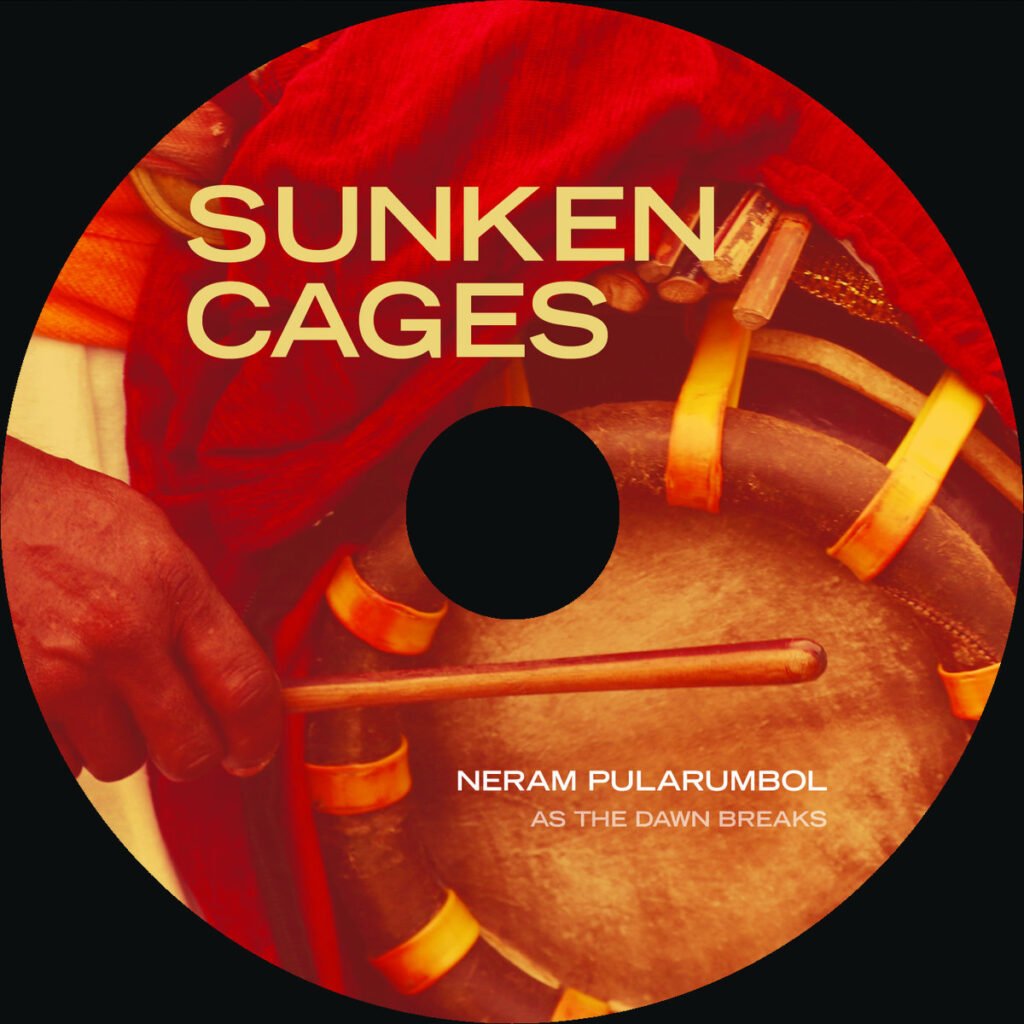
Ravish Momin has spent two decades proving that a drum kit is not a fixed object. The New York-based percussionist — who studied under Andrew Cyrille and has passed through the orbits of Kalaparusha Maurice McIntyre, Turning Jewels Into Water, and even a Depeche Mode remix — has always treated rhythm as something you can take apart and hand back changed. On Neram Pularumbol (As the Dawn Breaks), his second album as Sunken Cages, that instinct finally has a subject worthy of it: the temple drums of Kerala, instruments most listeners outside South India will never hear in the wild.
The record, out August 7 on the Bulgarian label Mahorka, arrives five years after Momin‘s debut, When The Waters Refused Our History. It contains six original compositions and six remixes, and the most compelling thing about it lives as much in the credits list as in the mixing. This is an album that keeps asking, quietly, who has the right to touch a tradition? It answers that question as much through who’s on the record as through how it sounds.
Momin builds his kits from instruments most Western listeners have no reference point for: the Chenda, a cylindrical drum with a taut double membrane struck with sticks; the Elathalam, a pair of thick bronze hand-cymbals with a bright, ringing chime; the Idakka, an hourglass-shaped drum central to Kathakali and Koodiyattam performance. These aren’t sampled off some royalty-free plugin. Momin has said the source recordings came primarily from Krishna Kishor, a session percussionist he credits by name, supplemented by additional South Indian sample packs he purchased and licensed rather than lifted. He’s also been candid that being Indian himself didn’t exempt him from that responsibility — sampling percussion traditions from regions and communities outside his own would still have been appropriation if he hadn’t paid for the privilege of using them. It’s a small admission, but it tells you the values driving the record before a single track plays.

That groundwork matters because the production choices that follow are aggressive. Momin doesn’t use these drums as color; he rebuilds his entire electronic vocabulary out of them, mapping sampled hits onto Ableton drum racks and then performing them live on an e-kit and mesh pads, looping and re-triggering in real time before returning to the studio to sculpt the results. On “Kerala” and “Elephant Dance,” that process is audible: temple brass and tavil patterns get locked into a tight kick-drum grid until the ceremonial source material starts to sound engineered, and by the time a heavily processed vocal cuts across “Elephant Dance” — garbled enough to read as one voice or a whole crowd — the recording has stopped documenting a ritual and started arguing with it.
The album’s midsection turns outward. On “Darantee,” Kuza — a South African vocalist trained in classical technique, now based in Athens, Georgia — has her voice folded into the percussion arrangement, treated more like a rhythmic instrument than a lead vocal. “Athiraavile” pairs Momin with Rani Jambak, an Indonesian vocalist with roots in Minangkabau tradition. Here the vocal cuts across the rhythm instead of riding inside it, breaking the momentum the album had been building.
What’s notable, reading Momin‘s own account of the record, is who he chose to call. He’s said outright that he wanted to spotlight women artists he’d been drawn to — Devi Mambouka (recording as Masma Dream World), El Kontessa, Rani Jambak, Lila Tirando a Violeta — alongside Kush Arora and Kuza, with the label filling out the remix roster from Hungary, Sweden, the Philippines, Germany, and Australia. That’s not a marketing detail. On a record explicitly built from a tradition Momin doesn’t want to hoard, deciding who gets invited into the room is itself a compositional choice, arguably as deliberate as any EQ curve.
The remixes bear that out. Kush Arora nearly doubles the pace of “Idakka” into a hard-panned footwork edit, chopping the drum and vocal samples down until the low end carries most of the track. Masma Dream World, the recording name of Devi Mambouka, slows “Kerala” into something closer to a horror-score cue — patient, unresolved, faintly threatening. The three producers who each take on “Drum and Flowers” pull it in different directions: Weldroid mastered the whole record; here he returns to gut the track down into something closer to a broken game cartridge. Lila Tirando a Violeta digs out a bassline the original never foregrounded and steers it toward a loose, jazz-adjacent club groove threaded with street noise. El Kontessa leaves the drums mostly intact and detunes them instead, so the hand percussion slides and warps underneath. Moki McFly gets the last word, taking “Kerala” out through a stretch of loose, semi-improvised percussion that trades precision for release. None of these remixers are asked to flatten the source material into something more palatable. They’re given room to argue with it.
It would be easy to hear Neram Pularumbol as a record about hybridity — East meeting West, acoustic meeting digital, the usual frame critics reach for when a South Asian artist picks up a laptop. That frame undersells what Momin is doing. The record’s real subject is the labor, permission, and specific human collaboration sitting underneath any music that gets called “global,” and its most persuasive argument shows up in the accumulation of names: Krishna Kishor, Kuza, Jambak, Mambouka, Arora, Weldroid, El Kontessa, Lila Tirando a Violeta, McFly. Nobody here functions as a sample pack.
That same logic extends past the music. Momin has also put together practical resources — including a spreadsheet template — to help musicians without institutional backing work out whether a given tour will actually pay for itself. It’s unglamorous, structural work that rarely makes it into a record review, but it clarifies what he means by reciprocity. An artist this concerned with who gets paid and credited off the road is, unsurprisingly, just as careful about it on record.
Neram Pularumbol (As the Dawn Breaks) doesn’t tie off the tension between honoring a tradition and reinventing it, and that refusal is exactly the achievement. Across twelve tracks, Momin routes Kerala’s temple drums through South Africa, Indonesia, Uruguay, Egypt, Hungary, Sweden, the Philippines, and San Francisco, pulling in a genuinely global cast — Kuza, Rani Jambak, Kush Arora, Masma Dream World, Weldroid, Lila Tirando a Violeta, El Kontessa, Moki McFly — and somehow keeps the whole thing cohering into a single, unmistakable artistic vision. That’s a difficult trick to pull off, and this record pulls it off with seamless elegance. Few albums this ambitious in scope manage to sound this assured in execution. It’s a genuinely significant piece of work: generous, meticulously credited, and glass-welded together across more genres and continents than most artists attempt across an entire career, let alone one release.
Neram Pularumbol (As The Dawn Breaks) by Sunken Cages released on the 7th of August 2026 on Mahorka